
12.8.1 What are Natural Resources?
Natural Resources are the natural elements that we use in everyday life and production. These resources such as water, soil and air, coal, gases and minerals are elements which societies throughout time have used to gain economic growth and wealth; and which are still applicable to the economic growth of a country, and particularly the farming industry.
We need to manage natural resources responsibly to ensure a prosperous life for future generations. Natural resource management can be defined as the responsible supervision or handling of these resources.
12.8.2 Natural Resource Management
Natural resource management involves the best utilisation of resources for human purposes while preserving natural systems. A farm entrepreneurs’ main asset is the land. It is therefore the duty of all parties involved in the line of production to make sure that the available resources within a farm are used and managed correctly. This will include the overseeing of workers and how they use resources, the analysing of data, and developing environmental plans in accordance with the policies and laws which govern the correct use of natural resources within the country.
It is important for the farm entrepreneur to have a functional understanding of available resources, their composition, the turnover accumulated from the natural resources, as well as their economic value.
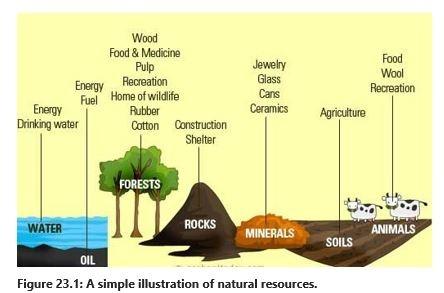
Source: http://www.eschooltoday.com/natural-resources/what-is-a-natural-resource.html
Natural resources, especially soil, water, plant and animal diversity, vegetation cover, renewable energy sources, climate, and eco-system services are important for the establishment and production cycles of all agricultural systems as well as for social and environmental sustainability. According to studies that have been conducted throughout the years, the striving of global agricultural development has been narrowly focused on increased productivity rather than on the welfare and the sustainable management of the earth.
Food security is the outcome of proper natural resource management skills and practices. Adopting a systems-oriented approach is preferable because it can address all the challenges that are associated with the complexity of food and other production systems in different ecologies, locations and cultures.
12.8.3 Sustainable Land Management
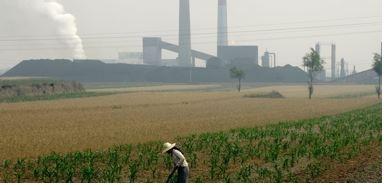
According to the United Nations, Sustainable Land Management is the use of resources such as water, plants, animals and soil to produce goods that meet evolving and changing human needs while simultaneously ensuring the long-term production potential of those resources and the maintenance of their functions within the environment.
The productivity and sustainability of a land use system is determined by how climate, human activity and land resources work together. Climate change impacts land use and functions within the farm, affecting even market viability. Implementing a sustainable land management programme is critical in the reduction of land degradation, the rehabilitation of land, and maximising the ability of these resources (water, land as well as biodiversity) to be replenished.
Land is an important aspect of environmental management as it includes source/sink functions for greenhouse gasses, the recycling of nutrients, the amelioration and filtering of pollutants, and the transmission and purification of water as part of the hydrologic cycle.
The main goal of Sustainable Land Management is to ensure that there is a symbiosis of natural resources; and for future generations to benefit from the environmental, economic, and social welfare provided for by natural resources. It combines ever-evolving technologies, policies and activities using socio-economic principles to both maintain and enhance production and reduce the level of production risk, and to protect soil and water quality.
Within the farming business production systems, there must be an evaluation system that records the use of land and how it is either benefiting or contributing to the deterioration of natural resources. Any evaluation of sustainability must be based on these objectives: productivity, stability/resilience, protection, viability, and acceptability/equity (Smyth and Dumanski, 1993). These pillars have been field tested in several countries and have been
judged to provide useful guidance for assessing sustainability.
The inability of some farmers to understand the bigger picture in sustainable land management and the importance of managing their land without diminishing its long-term profitability, viability, value and quality, will cause their operations to fail. Some problematic approaches include:
- Use of the land (soil) with no risk management plans in place
- Poor management of natural resources within the farm,g. water management systems, veld management and control camps for proper utilisation of grazing pastures (incompetence, no vision or understanding of production systems)
- Not understanding marketing functions and trade systems within the industry
- No consideration of the overall health and safety of the environment (biodiversity, animals, plants) as well as the workforce in terms of handling equipment and chemicals (vaccination procedures, fertiliser programmes, protective equipment, etc).
With this in mind, we need to consider how cattle farming relates to ecology.
12.8.4 Ecological cattle production:
12.8.4.1 Introduction :
The following is an extract from the book Ecological Cattle Farming by Dr Andre Mentz, who is hereby acknowledged for his contribution to practical beef cattle management.
“Any form of agricultural production is always a process, because of the time and circumstances involved. In any form of farming, we need to know the amount, volume, or weight produced per unit space, like hectare, in a year. The word ‘production’ is the biggest problem in cattle farming. People do not understand what it means in the context of a farm’s cattle herd. In the field of genetics and improvement schemes, the biggest misuse of the word is its association with performance. That is wrong. Production is production, measured by the kilogram of live mass yield per hectare, or in terms of efficiency per live mass input. Breeding values, heredity or whatever individual performance have nothing to do with live mass yields.
The natural life cycle (on veld) of cattle in a low-cost farming operation is normally three years. This is because a cattle herd on a farm has different classes. The normal composition of a herd is cows, calves, yearlings, young stock, replacements, store stock (steers) and culled breeders. Within three years after birth, the heifer progeny should have been calved and the steer progeny should have been marketed as fat slaughter animals. There is a correlation in a herd between the age of heifers, when they are well developed to calve and raise a calf, and the age of steers ready to be slaughtered. All culled females, heifers and cows, can be marketed at any time during the year when they are ready to be slaughtered. In a well-managed herd, the number of slaughter cattle a year would correspond to the number of births, to keep the herd’s numbers sustainable.
The basic functions of a cattle herd are to consume the pasture’s production and deliver their product (live mass) for sale. A cattle farm’s output is live mass and the income it earns derives from selling live mass at a tariff per kilogram per grading level. Cattle’s production management is a holistic action that includes the whole of the herd’s welfare, pastures, infrastructure, grazing system and any assets that will harm profits.
The ideal for a cattle herd is to be adapted to the natural veld of the farm without any supplementation. If the cattle lose weight (within limits) during winter or dry periods and continue to perform well in reproduction, growth, lactation and fattening, it is proof of very good pasture management and cattle’s adaptability. Grazing must be the only source of energy intake if it is to be a sustainable farming unit.
Spokesmen use all kinds of words to explain adaptability in cattle. Only one description is valid: a herd of cattle must be able to achieve all four of its life functions (growth, reproduction, lactation and fattening) efficiently on veld in cycles of three years, as explained previously. By doing so, every individual in the herd increases to its maximum value, until it’s time to be slaughtered. That, and nothing else, is the essence of real cattle husbandry.
Success in cattle farming embraces much more than calving percentage, weaning mass, or kilogram live mass output per hectare. The most important assets of a cattle farm are the soundness and health of its soil and pastures, as represented by the level of diversity. Measuring success should consider the status of every component of the ecology of a farming enterprise and the performance of the cattle herd, as described above
12.8.4.2 From universe to microbes
It is important to understand that the practice of agriculture, in whatever form, is a function dependent on ecosystems. To be sustainable in livestock farming, the operations must fit exactly into unique circumstances. If they don’t, there can be no integrity in the practice of cattle farming. And that’s what happens when spokesmen advise farmers to import new breeds not adapted to deliver normal production yields.
Cattle farming does not start with cattle. Please see this as one of the most important messages of this module. It might be a shock for cattlemen to read that cattle are not the ‘one and only’ of cattle farming. But if you accept this statement, you will better understand what this module is about. Cattle farming does not start with cattle. The following diagrams clarify cattle farming’s natural origin and purpose.
Figure 23.2 illustrates a little of the vital position of the earth in the solar system and some of the external systems keeping everything intact.
Figure 23.3 shows something of the innumerable internal ecological systems of our planet, created to sustain life on earth.
Figure 23.4 takes the cattle farm closer to the systems from which it originated.
The final reality of a cattle farm in nature is demonstrated in Figure 23.5, which, of course, differs greatly from the present views of the status quo.
The main message of the illustrations in figures 23.2, 23.3, 23.4 and 23.5, is that the survival of the creation from macro to micro level is a result of a balance of ecological systems, including all the organisms inhabiting them. We cannot meaningfully isolate anything, let alone control the variables. The same laws of nature that control the cosmos are present in the numerous eco systems of the sea and continents, and in the nature and soil of every farm. Therefore, every farm on earth, with its local ecosystems, no matter how different they may be, is part of a global network of ecosystems. A quote from Savoury & Butterfeld (1999) say in this connection: “The earth’s atmosphere, its plants, animal and human inhabitants, its oceans, plains and forests, its ecological stability, and its promise for humankind can be grasped only when they are viewed in their entirety. Isolate any part, and neither what you have taken nor what you have left behind will be as it was when all was one.
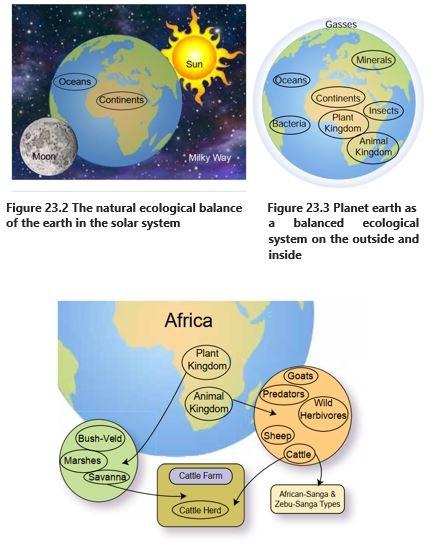
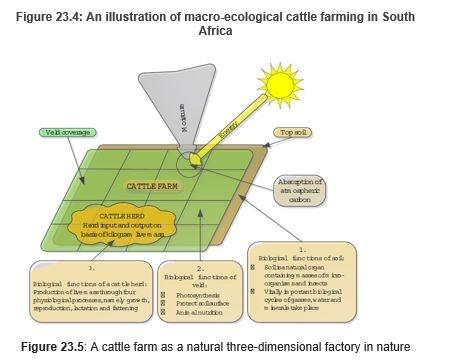
Figure 23.5 illustrates eco cattle farming as a whole, highlighting the following:
- A sustainable, biological factory marketing veld-reared beef cattle.
- Healthy soil is the first and most important component. It is home to sound biological activities that give rise to optimum quantity and quality forage, high in minerals and proteins. Healthy soil depends on the grazing system.
- The success of the system, measured by the quantity and quality of the product marketed (live mass), depends on how the sub-systems function to the benefit of each other.
- If a farm is to be sustainable financially, its main aim will be a low-cost operation using veld adapted cattle that can complete their production cycle within three years, with zero or very little support. Only basic lick elements such as salt, phosphate and urea are supplied when necessary.
- Management has no control over rain and sunshine, but by well-planned grazing of the camps, using animals as the instruments, many beneficial effects can be retained.
12.8.4.3 Identity: Obey the values
In the light of the foregoing, the farmer must commit to the following:
- Recognise every square metre of a farm’s soil as a natural life-giving body because of its biological, chemical and physical components.
- Recognise the ecological interaction between natural veld and livestock: both grow, reproduce and breathe, and their foodstuffs are essentially the same chemical compounds.
- Grass is the start of the food chain for man and animal; it is the life-artery that feeds the earth and is second in importance only after the soil in livestock production.
- Human food comes directly and indirectly from grass, as crops such as maize, wheat, rice and sugar are grass species. Livestock-derived products, such as meat and milk, comes from grass-eating animals.
- Cattle are ruminants (herbivores) that maintain their life-cycle on veld and can deliver the highest quality beef and healthy animal products only if adapted to their environment and knowledgeably and holistically managed.
- Eco cattle production systems contribute to the withdrawal of atmospheric carbon; they are a buffer against desertification and establish an appreciation of the value of plant and animal capital.
- Eco cattle farming can be evaluated statistically.
- Eco cattle farming is a system of continual vibrancy and personal fulfilment, depending on the enthusiasm of management for this approach.
- Livestock farmers are in a unique position to work, produce and live in harmony with the assets of nature, the ecology and animals. We are fortunate in Africa to have indigenous livestock and a superb ecology. We should respect and use them to their optimum sustainable levels.
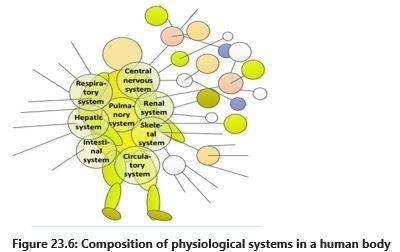
12.8.4.4 Identity: the holistic nature of everything
The human body is a good example of a holistic system with sub-systems that function independently and jointly to maintain health and life. This functionality can be directly compared to the holistic management approach in a cattle farming enterprise. Figure 23.6 shows the functioning and connection of the eight major physiological systems through the organs. This might not represent one per cent of the activities inside the human body, however it simply illustrates that a human cannot survive if any part of a system or subsystem is removed (without medical intervention). Similarly the “physical body” of the cattle farming operation needs major systems and many sub-subsystems to be alive and fully functional.
The two definitions at the beginning of this module describe some of the numerous aspects to be accommodated on a cattle farm. They are:
“enterprise, demarcated area, camps, veld utilisation, grazing systems, concentration and types of plants, symbiosis, climate, wild-life, soil type, micro-life, cattle herd size, carrying capacity, yield of veld, slaughter-cattle, live mass, turnover, yearly, sustainability, profitability, management, eco cattle production, natural life-cycle, managed in herd context, natural veld, live mass yields, growth, reproduction, lactation, fatten, deliver, high quality, eco red meat, no interference, nutrition, genetics, physiology, adaptability, value appreciation.”
These aspects by no means cover everything about cattle farming. As with the image of the human body in Figure 23.6 it is not possible to draw a diagram that includes all aspects of a cattle farming operation. Remember Figure 23.5 where the major biological activities are illustrated as deriving from the soil, grass and cattle. The farming operation must be viewed holistically.
12.8.4.5 Identity: Evaluation of cattle production yields
In addition to the above-mentioned principles, values, definitions and criteria for cattle farming, a few more thoughts are important:
In beef cattle production, the beast itself is the final marketed product, not like eggs from hens, or wool from sheep. Decision-making in eco cattle production depends on two aspects:
- Type of carcass: weight, size, conformation, fat covering within various age classifications;
- What type of breed is best adapted on the veld for its total life-cycle to deliver such carcasses?
Live mass is the pivot on which everything in cattle production hinges (not production traits, breeding values, genetic status, etc.):
- Live mass is the criterion for measuring production.
- Live mass of every individual, or class, or herd is a function of nutrition.
- Live mass is generated by life functions, which depend on nutrition.
- Live mass delivers live mass, which is the product of cattle’s production.
- Live mass production yields per hectare are the criteria for a herd’s interaction with the farm under given management.
- Live mass is delivered by every class in a herd. The whole herd is included when one measures live mass yields.
- Live mass input (live mass load) versus output (yield) by the whole herd, is the criterion for management’s efficiency of production (turnover).
- Live mass quality is mainly a function of carcass fat (condition).
- Live mass determines the volume of voluntary fodder intake (2,5% dry matter per kilogram live mass per day)
- Live mass of individuals, or their conformation or size, has no correlation with production yield of the herd per given fodder capacity.