
9.4.1 IMMEDIATE FINISHING / INTENSIVE SYSTEM
This system refers to feeding on high quality feed, consisting of mostly grain with less roughage. The objective is to finish the feeder in the shortest period for sending to the abattoir.
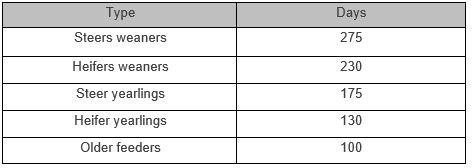
The feeding period objective for immediate finishing is on average:
In this system, backgrounding and preconditioning of weaners is very important to ensure that the animals have been introduced to grain, as young animals may take up to several weeks to be introduced to high rations of grain feeds. Yearlings and older animals therefore adapt easier to immediate finishing. Whole grain can be fed; however, if feeding cereal grain other than oats cracked or rolled grain is best for minimum wastage. If it is not cracked or rolled, approximately 20% of the grain will not be digested.
Advantages
- The cost of weight-gain is reduced due to the use of grain as a less expensive source of energy (e.g. cereal grains), and the cost of mixing and handling of concentrates, versus roughage.
- Cereal grain feeding can decrease manure production versus ad libitum consumption of roughage-based diets.
- Intensively fed calves are generally more efficient than calves subjected to extensive production systems.
- A high-concentrate diet is fed to provide a specified rate of gain.
- Using this approach to achieve similar gains may improve feed conversion dramatically versus those fed a corn-silage-based diet.
- There are no detrimental effects on finishing performance, but the incidence of liver abscesses may increase by feeding all-concentrate diets during both the growing and finishing phases.
Disadvantages
Intensively fed cattle put on more fat and finish at lighter weights, thus producing light carcasses. But with large-framed cattle, this can produce carcasses within an acceptable range for the packing industry.
9.4.2 DEFERRED FINISHING / EXTENSIVE SYSTEM
In contrast to immediate finishing, deferred finishing refers to a system of more roughage and less grain. These types of feeders may buy calves in autumn (April / May) from producers who cannot overwinter the animals, and who then overwinter the animals on good natural roughage, whilst introducing small amounts of grain to boost energy levels. Calves kept on the pastures with grain supplements for between 90 – 120 days will gain between 0.6 – 1.7 kilograms per day in weight.
In early spring (August/ September), the following two routes of fattening can be followed:
Straight to an intensive feedlot for 90 – 120 days where calves are fed intensively with mostly grain, or;
The calves can be kept on the natural pastures (with or without grain supplement) until April to May the next year. Thereafter they are put into an intensive feedlot for 120 – 150 days, to be marketed around September/ spring.
9.4.3 THE USE OF PLANTED PASTURES AND CROP RESIDUES
Planted pastures can be used for fattening and growing out animals and growth rates achieved are better than on the veld. The most common practice is the use of annual ryegrass, where weaners go on to the pasture at weaning in autumn and are ready for the market by December/Christmas. Although summer pasture e.g. kikuyu can be used, this practice is often not successful because feeding starts in spring when the price of feeders is relatively high and finished animals are only ready in autumn, when beef prices are relatively low.
Farmers also use cattle to feed on maize and wheat residues after harvesting in June/July, until the residues are finished by September-October. Many farmers sow ryegrass or oats between the rows of maize during planting time (September – December), which provides an excellent mixture of high-quality maize rests and high protein green feeding.

A mixed cropping system of high-quality forage for late-fall and early winter grazing for cattle and young calves